In today’s hyper-competitive global insurance landscape, efficiency and customer-centricity are no longer optional – they are survival requirements. Enterprise Resource Planning (ERP) systems offer a powerful backbone for managing core business processes, from finance and accounting to HR and supply chain. However, ERP alone often falls short when it comes to nurturing customer relationships and driving sales growth. This is where Customer Relationship Management (CRM) systems step in, unlocking the true potential of ERP and transforming global insurance companies into agile, customer-obsessed organizations.
Imagine a world where your ERP system meticulously tracks policy claims, while your CRM system simultaneously analyzes customer interactions to identify potential cross-selling opportunities. Or picture your finance department leveraging ERP data to forecast revenue accurately, informed by the real-time customer insights captured in your CRM. This synergy between ERP and CRM is not just a technological advantage; it’s a strategic imperative that empowers insurance companies to optimize operations, enhance customer experiences, and achieve sustainable growth on a global scale.
This comprehensive guide delves into the intricate relationship between CRM and ERP within the context of global insurance companies. We’ll explore how CRM complements ERP, the key features that drive value, and the practical steps you can take to integrate these systems effectively. Whether you’re a seasoned IT professional or a business leader exploring digital transformation, this article will provide you with the knowledge and insights you need to unlock the full potential of CRM and ERP for your organization.
Understanding the Synergy: CRM and ERP in Insurance
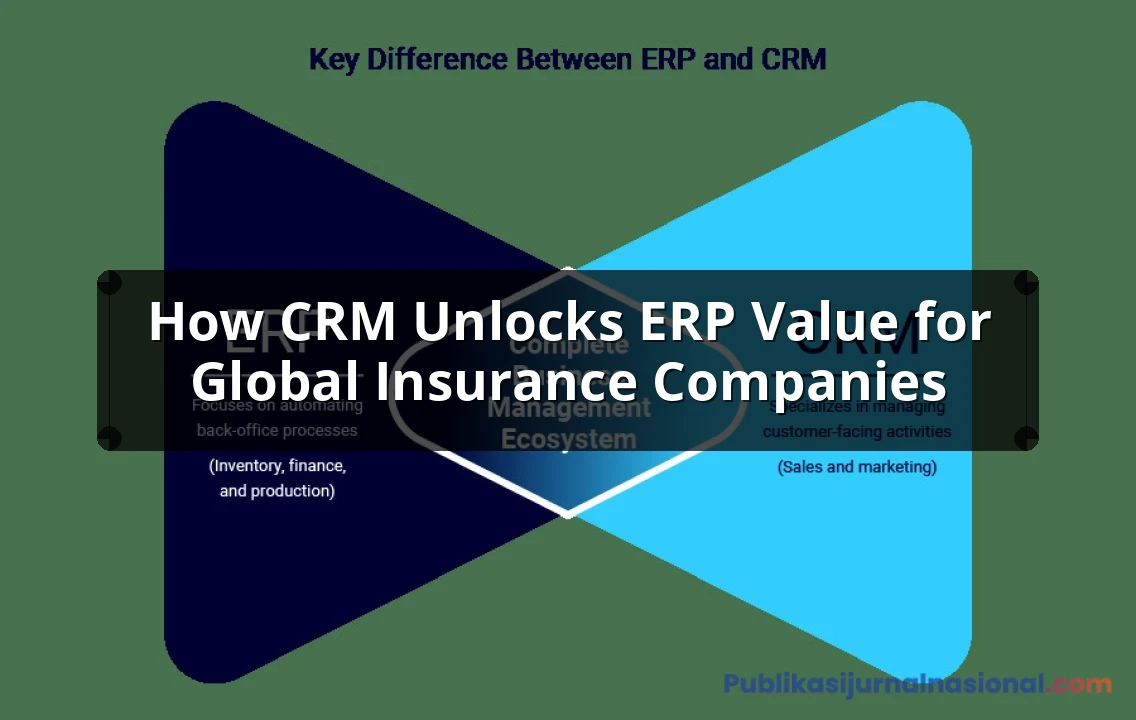
While both CRM and ERP systems are crucial for modern businesses, they serve distinct purposes. ERP focuses on internal operations and resource management, while CRM centers on customer relationships and sales. In the insurance industry, this distinction is particularly important, as customer trust and personalized service are paramount.
ERP: The Operational Backbone
ERP systems manage core functions such as:
- Finance and Accounting: General ledger, accounts payable/receivable, budgeting, and financial reporting.
- Policy Administration: Managing policy lifecycle, including issuance, renewals, and cancellations.
- Claims Management: Processing claims, managing payouts, and handling fraud detection.
- Human Resources: Managing employee data, payroll, benefits, and recruitment.
- Compliance and Regulatory Reporting: Ensuring adherence to industry regulations and generating necessary reports.
ERP provides a centralized platform for data management, streamlining processes and improving efficiency across departments. It’s the engine that keeps the insurance company running smoothly from an operational perspective.
CRM: The Customer-Centric Front End
CRM systems focus on:
- Sales Management: Tracking leads, managing opportunities, and forecasting sales.
- Marketing Automation: Creating and executing marketing campaigns, managing email marketing, and analyzing campaign performance.
- Customer Service: Handling customer inquiries, resolving issues, and providing support through various channels. This strategy impacts How To CRM Build ERP Strategy For High-Value for sales and marketing.
- Customer Data Management: Centralizing customer information, including contact details, policy history, interactions, and preferences.
- Analytics and Reporting: Providing insights into customer behavior, sales trends, and marketing effectiveness.
CRM empowers insurance companies to build stronger relationships with customers, personalize interactions, and improve customer satisfaction. It’s the face of the company to the customer, ensuring a positive and consistent experience.
How CRM Unlocks ERP Value
The true power lies in the integration of CRM and ERP. CRM data enriches ERP processes, and ERP data empowers CRM activities. Here’s how:
- Improved Customer Insights: CRM provides a 360-degree view of the customer, which can be integrated with ERP data to provide a comprehensive understanding of their needs and preferences. This allows for more personalized service and targeted marketing campaigns.
- Enhanced Sales Performance: By integrating CRM with ERP, sales teams can access real-time information on policy status, claims history, and payment information. This empowers them to identify cross-selling and upselling opportunities and close deals more effectively.
- Streamlined Claims Processing: CRM can be used to capture initial claims information and trigger automated workflows in ERP, speeding up the claims process and improving customer satisfaction.
- Better Marketing ROI: Integrating CRM with ERP allows for more targeted marketing campaigns based on customer data and policy information. This leads to higher conversion rates and improved marketing ROI.
- Improved Operational Efficiency: By automating processes and providing real-time data access, the integration of CRM and ERP can significantly improve operational efficiency across the organization.
Key CRM Features for Global Insurance Companies
Not all CRM systems are created equal. Global insurance companies require specific features to address their unique needs and challenges.
Policy Management Integration
Seamless integration with policy administration systems (often part of the ERP) is crucial. This allows agents and brokers to access policy details, coverage information, and renewal dates directly from the CRM, providing a complete view of the customer’s insurance portfolio.
Claims Management Support
CRM should support the claims process by allowing agents to log claims, track their status, and communicate with customers throughout the process. Integration with the ERP‘s claims management module is essential for efficient claims handling.
Compliance and Regulatory Features
Global insurance companies must adhere to a complex web of regulations. CRM systems should include features to help manage compliance requirements, such as data privacy regulations (e.g., GDPR, CCPA) and industry-specific regulations.
Multi-Language and Multi-Currency Support
For global operations, CRM must support multiple languages and currencies to cater to diverse customer bases and ensure accurate financial reporting.
Mobile Accessibility
Agents and brokers need access to CRM data from anywhere, at any time. Mobile accessibility is crucial for enabling them to provide on-the-go service and close deals while in the field.
Advanced Analytics and Reporting
CRM should provide robust analytics and reporting capabilities to track key performance indicators (KPIs), identify trends, and measure the effectiveness of sales and marketing initiatives. This includes custom report generation and dashboarding capabilities.
Lead Management and Distribution
Effective lead management is crucial for driving sales growth. The CRM should allow for automated lead capture, scoring, and distribution to the appropriate agents or brokers based on their expertise and location.
The Implementation Process: Connecting CRM and ERP
Integrating CRM and ERP is a complex undertaking that requires careful planning and execution. Here’s a step-by-step guide to ensure a successful implementation:
Define Clear Objectives and Scope
Start by defining your business goals and objectives for the integration. What specific problems are you trying to solve? What improvements are you hoping to achieve? Clearly define the scope of the project, including which modules and data will be integrated.
Choose the Right Integration Approach
There are several integration approaches to choose from, including:
- Direct Integration: Connecting CRM and ERP systems directly through APIs or custom code. This approach offers the most flexibility but can be complex and costly.
- Middleware Integration: Using a middleware platform to facilitate data exchange between CRM and ERP. This approach simplifies the integration process and provides a more scalable solution.
- Embedded CRM: Choosing a CRM system that is tightly integrated with your ERP system from the same vendor. This approach offers seamless integration but may limit your choice of CRM solutions.
The best approach depends on your specific needs, budget, and technical expertise.
Data Mapping and Cleansing
Carefully map the data fields between CRM and ERP to ensure accurate data transfer. This includes identifying duplicate data, resolving inconsistencies, and cleansing data to ensure quality. Data quality is paramount for the success of the integration.
Develop a Testing Plan
Thoroughly test the integration to ensure that data is flowing correctly and that all functionalities are working as expected. Develop a comprehensive testing plan that covers all use cases and scenarios.
Train Your Users
Provide comprehensive training to your users on how to use the integrated CRM and ERP systems. This will ensure that they understand the benefits of the integration and can effectively leverage the new functionalities.
Monitor and Optimize
Continuously monitor the performance of the integrated systems and make adjustments as needed. Identify areas for improvement and optimize the integration to maximize its value.
Overcoming Common Challenges in CRM and ERP Integration
While the benefits of CRM and ERP integration are significant, there are also several challenges that organizations may face:
Data Silos
One of the biggest challenges is breaking down data silos between CRM and ERP. This requires careful planning and data mapping to ensure that data is shared seamlessly between the two systems.
Complexity
Integrating complex systems like CRM and ERP can be technically challenging. It requires skilled IT professionals with expertise in both systems.
Cost
The cost of integration can be significant, including software licenses, implementation services, and ongoing maintenance.
Resistance to Change
Users may resist adopting new systems and processes. It’s important to communicate the benefits of the integration and provide adequate training to overcome resistance.
Data Security
Integrating CRM and ERP can raise data security concerns. It’s important to implement appropriate security measures to protect sensitive customer data.
The Future of CRM and ERP in Insurance
The integration of CRM and ERP is becoming increasingly important in the insurance industry as companies strive to deliver personalized experiences and optimize operations. Looking ahead, we can expect to see the following trends:
AI and Machine Learning
AI and machine learning will play an increasingly important role in CRM and ERP, enabling companies to automate tasks, personalize interactions, and gain deeper insights into customer behavior.
Cloud-Based Solutions
Cloud-based CRM and ERP solutions are becoming more popular, offering greater flexibility, scalability, and cost-effectiveness.
Increased Automation
Automation will continue to drive efficiency improvements in both CRM and ERP, reducing manual tasks and freeing up employees to focus on more strategic activities.
Personalized Customer Experiences
The focus on personalized customer experiences will intensify, with CRM and ERP playing a key role in delivering tailored products and services.
Data-Driven Decision Making
Insurance companies will increasingly rely on data from CRM and ERP to make informed decisions about product development, marketing, and sales strategies.
Conclusion: Embracing the Power of Integrated Systems
In conclusion, the integration of CRM and ERP is a strategic imperative for global insurance companies seeking to thrive in today’s competitive landscape. By connecting these two powerful systems, insurance companies can unlock a wealth of benefits, including improved customer insights, enhanced sales performance, streamlined claims processing, and better marketing ROI. While the implementation process can be challenging, the rewards are well worth the effort. By carefully planning and executing the integration, insurance companies can transform their operations, enhance customer experiences, and achieve sustainable growth on a global scale. Embracing the power of integrated CRM and ERP systems is no longer a luxury; it’s a necessity for survival and success in the modern insurance industry.
Frequently Asked Questions (FAQ) about How CRM Unlocks ERP Value for Global Insurance Companies
How does CRM improve ERP data for insurers?
CRM systems enhance ERP data quality by capturing accurate customer information at every interaction. This enriched data improves ERP reporting, leading to better business decisions for insurance companies.
Can CRM streamline insurance claims using ERP?
Yes, CRM integrates with ERP to automate claims processing. This integration provides real-time access to policy and customer data, speeding up resolution times and improving customer satisfaction.
Does CRM help insurance sales forecasts in ERP?
CRM improves sales forecasting accuracy within ERP. By capturing sales pipeline data and customer preferences, CRM enables more precise revenue projections for insurance products, optimizing resource allocation.